By Rita Cui Qin Qin
“I have a dream in arts!” Dare to speak it out and do it? Then you’d better be ready to be different from the majority, dealing with the opposition of your family and even the pressure of life. However, there are still some post-80s artists who strive to pursue dreams in photography, design and literature, etc. Why are they doing it? What hardship do they face? And what efforts do they make to overcome difficulties? Bearing these questions in mind, you may find answers in stories of these two post-80 youngsters.
Season Lao, a multimedia designer and photographer who was born in the late 1980s, recently published his photo album Páteo do Mungo, and a documentary with the same name.
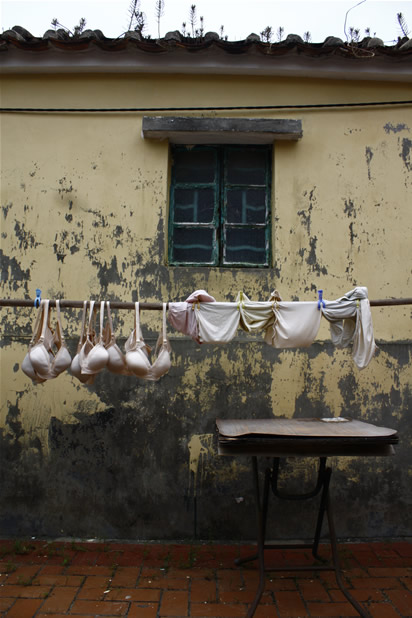
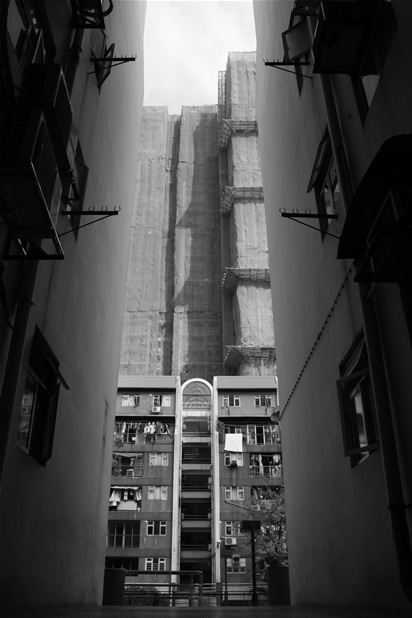
Páteo do Mungo is a small valley in Macao with a history of almost 100 years, where 13 southern Fujian architecture style houses with great heritage value are located. However, under the pressure of urban development, these houses are going to face the destiny of demolishing in the near future.
“Páteo do Mungo is the place where I was born and grew up. The purpose is not to stop the demolishing, but rather to record my memories about this place and to demonstrate a disappearing lifestyle which is based on traditional community in Macao,” Lao elaborated when talking about his work.
At the age of 20, Lao quit his job and went to Portugal to do a photographic project under the sponsorship of the Macao Cultural Institute. In the same year, his exhibition “A Macanese in Portugal” was held at the University of Macau (UM).
As the mainstream of Macao’s young people are engaged either in casinos or big companies, Lao’s decision to be involved in arts seems brave. “For young people, I think the most important thing is to improve the competitive strength and find what they really want to do. We can’t be so shortsighted. Even though working in casinos can earn a lot of money, the job is not stable. One cannot live on it for a lifetime,” Lao said.
Recalling the start of his career, he said, “I was not so sure how far I could go and whether I was really talented to enter the creative industry. But I tried first, to learn and to do the real design work to find my potential. There was a tough transitional period, from the interest to the career.”
With the consideration of relating his design with commerce, he said he did not have so much pressure.
Unlike Lao, Wong In In, a fourth year student of the University of Macau, also a former editor of a campus publication, said that her dream of literature took root in her high school, and was triggered after her poem was rewarded by the Macao Prize in Literature.
The Macao Prize in Literature is held every two years by the Macao Foundation and the Pen of Macao, and marked as the biggest literature event in Macao.
“At the beginning, literature for me is no more than an interest. But I was greatly encouraged and found my potential after being rewarded,” Wong recalled. After that, she participated in every session of the writing competition and was rewarded for the second time.
Now, facing the choice about the future, Wong said, “I won’t give up my dream in literature, although I know it’s not realistic to live on it. My solution is to find a job first and save money to support my further study.”
She already applied for a master program in Chinese in UM this March. “But I will work for one year and then continue my study. With a deeper knowledge of literature, now I treat it very seriously and I also feel the responsibility to inherit and develop Chinese literature,” Wong said.
However, the pressure form her parents is now her biggest obstacle. “They think that literature is useless and can’t help with my career. But their attitude seems to have eased up, since I promised to find a job first. I need more time to persuade them,” Wong said optimistically.
Besides, Wong also said that she has many friends who are in a similar situation. “They also face pressures and difficulties. But they’re very determined and working very hard to find a balance between the dreams and realities. I am also greatly encouraged by them,” Wong added.

 The term “post-80s” has been popular in media and society recently. It is important to explore the characteristics of this group of young adults aged between 20 and 30. While some consider this young generation as problematic and rebellious, others believe that the negative labels of the post-80s are just a false generalization established by the mass media.......