By Gary Lai Io Fai
While shocking news of sons and daughters born in the 80s killing their parents every now and then occupied media headlines in Hong Kong, China and Taiwan, giving a chilling impression that the post-80s generation lacks responsibilities towards their families, there are cases in Macao that prove the opposite.
“I want to earn more money so that my parents can retire and enjoy their life as early as possible,” says Jerry Choi, who graduated last year and is now working as a VIP host in a casino hotel. “I want to take my parents to travel once or twice a year,” he says.
Choi earns MOP15,000 a month, and he gives one-third of the salary to his parents as “family expenses”. He also contributes some of his earnings to the monthly installment of a flat in Zhuhai, China, where his parents will eventually move to, leaving the flat in Macao to him.
Working in a casino hotel, Choi has to work on shifts. He thinks that the relationship with his family is not as close as before. He recalls that his mum had once complained to him that she had not seen him for two weeks due to the “unusual” working hours. “I’ve noticed the problem, so I will spend as much time as possible with my family when I am free,” he says.
The post-80s generation in Hong Kong is generally perceived as disobedient and detached from their parents. They pay a lot more attention to their careers and friends than to their families. In China, the situation is similar—it is reported that the urban youth of middle classes seldom give money (or family expenses) to their parents even though they have their own job. Some scholars suggest that this phenomenon is due to the “one-child policy”, which leads to the situation that parents take excessive care of their children, and eventually spoil them.
However, this phenomenon is not evident in Macao. The post-80s generation generally conforms to the core value of the traditional Chinese culture: filial piety.
Filial piety, meaning to be loyal to one’s parents and ancestors, is considered the first virtue in the Chinese culture. It is one of the virtues to be held above all else in the Confucian ideals, as seen in the Confucian classic Xiao Jing (The Book of Filial Piety).
“I value my family, and I believe I am a good daughter of my parents,” says Glyceria Lok, another post-80s young adult who is a high school English teacher. “I feel guilty if I don’t take good care of my parents,” she adds.
Similar to Choi, Lok gives almost half of her monthly salary to her parents. She says she treats this as a habit, which she has learned from her parents. “When I was small, I saw my parents regularly give money to my grandparents,” she recalls.
Now she is saving money for continuing her studies. She wants to study abroad, which requires a large amount of money. However, she decided to pay by herself. “Paying for my studies is my responsibility, not my parents’,” she says.
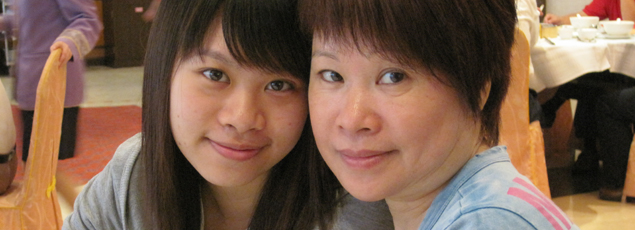
On the other side, some parents do not expect to get back what they have given to their children. Mrs. Iu, a police officer with one daughter born in the late 80s and one son in the early 90s, says that she does not have a great hope with her daughter, who has given up her university studies. “I just want her to be an ordinary daughter,” she says. “Now I’d rather put all my hope and anticipation on my son.”
 The term “post-80s” has been popular in media and society recently. It is important to explore the characteristics of this group of young adults aged between 20 and 30. While some consider this young generation as problematic and rebellious, others believe that the negative labels of the post-80s are just a false generalization established by the mass media.......