By Anna Chan Choi Cheng
Mum: “你做咩出去呀?” (Why are you going out?)
Daughter: “我要做project呀!”(I have to work on my project!)
Mum: “咩呀?” (What?)
Daughter: “…Project 呀!” (…Project!)
That is a common conversation between a mum and a university student in Macao.
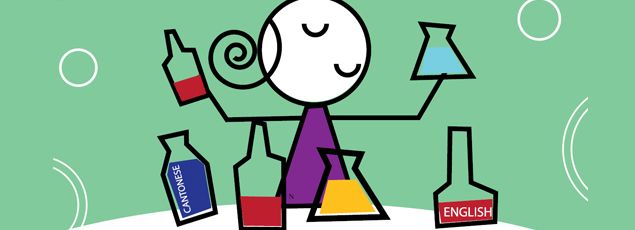
Most Macao residents speak Cantonese. If you listen attentively to the post-80s, however, you will find out many utterances like Okay啦. (It’s okay.), 我地一齊食lunch囉! (Let’s have lunch together!), 我係Facebook add 左你做friend啦! (I’ve added you as friend on Facebook!), Keep好啲你啲野! (Keep your belongings carefully!), or 聽日我有presentation呀! (I have a presentation tomorrow), which are not pure Cantonese. English words or phrases are often inserted into the dialogues which make their Cantonese a sort of mixed language.
A group of post-80s students were asked to tell the Cantonese equivalent for the word project. Interestingly, no consensus on that expression is achieved. They prefer to use the English word project instead. Regarding as to why they choose to use a mixed language, one of them said, “I do not intentionally use a mixed language but I tend to use that only when I cannot find proper expressions for some technical terms.”
The phenomenon of using a mixed language becomes fairly common especially among the educated post-80s and the younger generations in Macao. This is largely attributed to the impact of the Hong Kong media, as well as a rapid increase of English use especially in education, the Internet, commerce and tourism nowadays in Macao. Many of them are so accustomed to this “Cantonese” that they are not even aware of using English words to fill in their stylistic gaps of lexical items in Cantonese, while some think that it is cool to use a mixed language as it shows that they are more stylish, or simply, more educated.
Dr. Brian Chan Hok-Shing, assistant professor in the Department of English, University of Macau, points out that the widespread phenomenon of language-mixing started from the post-80s is largely due to their increasing contact with English in their daily lives. With or without intention, this phenomenon has been shaped naturally like a habit, and is even becoming a post-80s identity. Using a mixed language of Cantonese and English is unavoidable as it comes to symbolize a “solidarity marker” among them, Chan said. Culture and language are always interrelated and inseparable. We have freedom to be creative in speaking despite certain cultural constraints in Macao, he added.
Paddy Chan, a Year 4 student from Macau Polytechnic Institute, holds a different view on this issue. As one of the Macao-born post-80s herself, she finds this language-mixing phenomenon inevitable since Macao is a multi-lingual and multicultural city. Facing such a growing trend towards language-mixing, nonetheless, she adheres to the belief that the language integrity of Cantonese should be kept and respected, under any circumstances and for any reason whatsoever. “It is really weird not to be able to fully express ourselves with only our mother tongue,” she added.
Linguists named the mixture of two or more languages as “code-switching” or “code-mixing”. Using code-switching or code-mixing is not a matter of right or wrong, but an ongoing development of language instead. Critical communication scholars tend to argue that this phenomenon reflects the linguistic and cultural hegemony of certain world powers. However, code-switching or code-mixing seems to be an irresistible general trend and there is no way around it. Consider你發送個短訊畀我啦! (Send a message to me!) or simply你send message畀我啦! (Send a message to me!), which would you prefer to say?
 The term “post-80s” has been popular in media and society recently. It is important to explore the characteristics of this group of young adults aged between 20 and 30. While some consider this young generation as problematic and rebellious, others believe that the negative labels of the post-80s are just a false generalization established by the mass media.......